I've been embracing my stay-at-home mom status by watching (via PVR, natch) episodes of Oprah, The Farewell Season. I've been skipping a lot of the more morbid episodes, preferring instead to wile away the hours on the more energetic episodes, you know, the "favourite" things, stars promoting their latest films, J-Franz's book club appearance (how uncomfortable was THAT?). Most of the time I can ignore the overt marketing crap because I do think it's honourable to encourage people to read, to write, to live their "best" life, whatever that means. But never before has the sheer marketing value, the desperateness of various different high-profile brands been more apparent than when I was watching the Australian episodes.
Cue sappy, inspirational music as we come upon a very thin man with a beautiful wife and two gorgeous children. He's suffering from Australian cancer, which isn't much different from cancer in any other part of the world. But somehow, these people are special, they are undergoing tragedy. And I'm not belittling their suffering. My grandmother and uncle died of bowel cancer; it's an awful way to spend your last days. My point, though, is that the saints of Oprah-land deemed this particular couple worthy, and found a corporate sponsor, XBox Australia, to underwrite their suffering or, rather, to give them $250k so they can spend a year "enjoying" their lives instead of having to work so hard keeping everything together in the face of tragedy.
This got me thinking. Maybe that's what I need. A corporate suffering sponsor. I could blog about my trials and tribulations having an awful disease like Wegener's Granulomatosis (because, seriously, haven't we all heard enough about cancer, why not let some of the other diseases have the spotlight and the cash influx from companies looking to reformat their image in the age of social responsibility?). I could stand to cash a cheque for hundreds of thousands of dollars and spend the year recovering in the south of France or somewhere equally indulgent to my inner most and wildest dreams. I mean, who wouldn't?
But the whole idea is so repugnant, in a way. That some suffering is worthy of corporate sponsorship, simply because Oprah came to town and wanted to do some good (I'm not criticizing the intentions). What I'm more curious about is how the idea came about in the first place -- did XBox Australia sit down with Oprah's people and say, "we need to revamp our image and we'll do anything to get in bed with you, because you are the queen of all media and our time is running out, with this being the "farewell" season and all." Because it doesn't seem like a likely fit -- video games and cancer. Well, maybe I'm wrong. I guess I could have used some XBox while I spent three weeks in the hospital almost dying, then giving birth, and then almost dying again.
Maybe it's just sour grapes. Maybe deep down I'd love it if Stella McCartney or Jo Malone or Mac or Apple or some other giant brand that I actually respect and admire came calling to highlight my suffering for their own corporate greed. Wait, greed isn't the right word -- and marketing doesn't quite fit either, it's a strange combination of altruism for the sake of selling shit, and I know it's as old as dirt, the idea of companies giving back so that their brands are vital and necessary, and, well, front of mind, but I can't help but feel that it's tawdry to capitalize on someone's suffering regardless of how it must have felt to that family -- like winning the lottery. They are deserved of such a gift, that much is true, but I would love to see a lot more transparency -- it's not Oprah giving these gifts, she's simply allowing big, fat companies to ride on her coattails and allowing them to pat themselves on the back by doing "good" in her name.
And why is corporate generosity such a boon these days? You can't watch a single one of these daytime shows without the audience members receiving diamonds and computers and a whole host of other crap. And I'm not saying we don't do it either, gosh, we give away a lot of books, it's a good marketing ploy, but my company has never underwritten suffering the way XBox has -- they've never sponsored a tragedy in the name of "fun."
So, any company out there looking for a family undergoing some serious tragedy, we're here. We could use a little fun. We could use a little corporate social responsibility. And I promise I won't even mention the fact that my disease was ultimately discovered by a nasty Nazi doctor. Ooops. Maybe that's what's holding everyone back.
Monday, January 24, 2011


Sunday, January 23, 2011
#7 - The Empty Family
 Colm Tóibín's excellent book of short stories, The Empty Family, cements his presence as one of the writers working today whose prose I covet, envy, and ultimately am awed by. The title, as his interview in the National Post points out, reflects the idea that there's a dichotomy to family, in all its inclusiveness, there's also a separateness for those who move beyond the traditional, who haven't got family to depend upon, or who choose to abandon and/or create families from non-blood ties. All of the protagonists in these stories leave home, leave their families, leave the relative safety of their immediate lives for change whether it's necessary (in one story, a young Spanish girl who is involved with the communists goes abroad after being arrested) or simply for an adventure (another character lives and loves with abandon in Spain in 1975). And the results, are terrifically life altering.
Of the stories, my favourite would have to be "Two Women," where Frances Rossiter, an aging, successful art director who returns to Ireland to dress a film and has a chance encounter with the widow of her most enduring lover. The scene, set so simply, has so many underlying emotions that evoked, for me, Hemingway's "Hills Like White Elephants" where the real action remains in what's not being said instead of the actual conversation between the two characters. In fact, this is a particular stylistic affectation of Tóibín's writing, that there is so much left unsaid, awkward pauses melting between beautiful prose that illuminates the characters in ways that lesser writers would leave hanging. He can infer, and that's a talent that doesn't go unnoticed by me.
The stories are all vastly different; however, the ones where he uses "I", I couldn't help but imagine them linked in some way, the narrative giving voice to a protagonist that seems always to be at odds with the story itself in a way, like a literal interpretation of the book's title. As in the opposite of what "I" usually means: strong, individual, like Bob Marley's Rastafarian reinterpretation, his refusal to use anything but "I" -- these characters are not lacking but they are separate, outside in a way, alone, but not necessarily lonely, yet still feeling an ache. Funny, I can relate, in a way, it's kind of how I'm feeling these days, a distinct loss of "I" with the creation of my family. I am not, yet, in anyway empty, though.
My other favourite story from the collection would have to be "Silence." Lady Gregory fills up her life, a relatively happy life as a widow, with stories she tells, in secret, in code, to Henry James hoping that he'll turn them into prose. It's fascinating how she absorbs her guilt over an act of betrayal by slowly leaking the truth out in pieces that are overt lies to the writer. As if his written words will absolve her of her sins, should she actually think of them that way. But more so, to bring her feelings to the surface, to have them talked about in real society would be impossible, and so she makes up interesting ways for them to bubble to the surface that only she knows. The power of society, the impregnable rules for women, and the idea that marriage is simply a contract, regardless of how rich and/or happy it makes you, are all fascinating themes within.
In the National Post article that I linked to above, Tóibín mentions that there's a sentence from "The New Spain" that he's been holding on to for 23 years, that it took him that long to find the right place for those words. In a way, I find this so freeing -- as a writer who holds on to sentences for ages and consistently goes back to old notebooks for new inspiration, I can understand how it might feel to wait for just the right place for just the right words. And I am glad that Tóibín takes his time with these sentences, because the end result is nothing short of remarkable.
#6 - Blue Shoes and Happiness
 My Zombie Survival Guide daily calendar tells me that a motorcycle is the best way to flee an infested area, which could be problematic for me as I have never driven a motorcycle in my life. Oh well. That has absolutely nothing to do with Alexander McCall Smith's Blue Shoes and Happiness, which is the seventh book in the No. 1 Ladies Detective Agency series with Mma Ramotswe and her cast of likable characters. The calendar makes me laugh, that's all.
It's a breezy, delightful series, and I'm actually reading In the Company of Cheerful Ladies (#8) at the moment and expect to be finished it today, they're such quick books to get through. I had three of the series on my shelves, one I had already read, and so I decided just to power through the other two. I love how Mma Ramotswe isn't a traditional detective, while she may be traditionally built, and how the cases do not involve bloody murder of the Mo Hayder kind (although I do adore Ms. Hayder) but are instead more like moral lessons. Sure, there are mysteries to be solved but they are generally addressed through common sense and communication, traditional Botswana (I think?) values, and the essence of good for the sake of being good, no ulterior motives:
Most problems could be diminished by the drinking of tea and the thinking through of things that could be done while tea was being drunk. And even if that did not solve problems, at least it could put them off for a little while, which we sometimes needed to do, we really did.My thoughts exactly. A good cup of tea, a warm muffin, and a comfy chair and most problems can at least be mulled over, if not completely solved. In Mma Ramotswe's case, she drinks her beloved bush tea, in my case, it's decaf earl grey with the milk poured in first (and I couldn't give a toss what Christopher Hitchens would say about that -- it was the way my British grandmother taught me to drink tea and it tastes the best when the hot water scalds the milk, it just does). The point being that it is in the drinking of the tea that humanity comes together, not the making of the tea, although I would agree with Hitchens that finding a decent cup of tea in America isn't easy.
Annnywaaay, I'm off topic, entirely with this post, rambling on about zombies and Christopher Hitchens. There's not a lot to say about these novels, just that I adore them, adore the characters and can't wait for the TV show to come back on, because it's delightful too. What's also nice is that McCall Smith was born in Zimbabwe, which puts him on the map in terms of my Around the World in 52 Books, and the African settings of these books always make me want to travel to that continent, just to experience life in a different way. So I've knocked off a couple of challenges with two short novels, and haven't quite decided what my shelves will bring forth next in terms of what I'm in the mood to read.
Friday, January 21, 2011
Notes From A House Frau IX
 The Magic Marker?
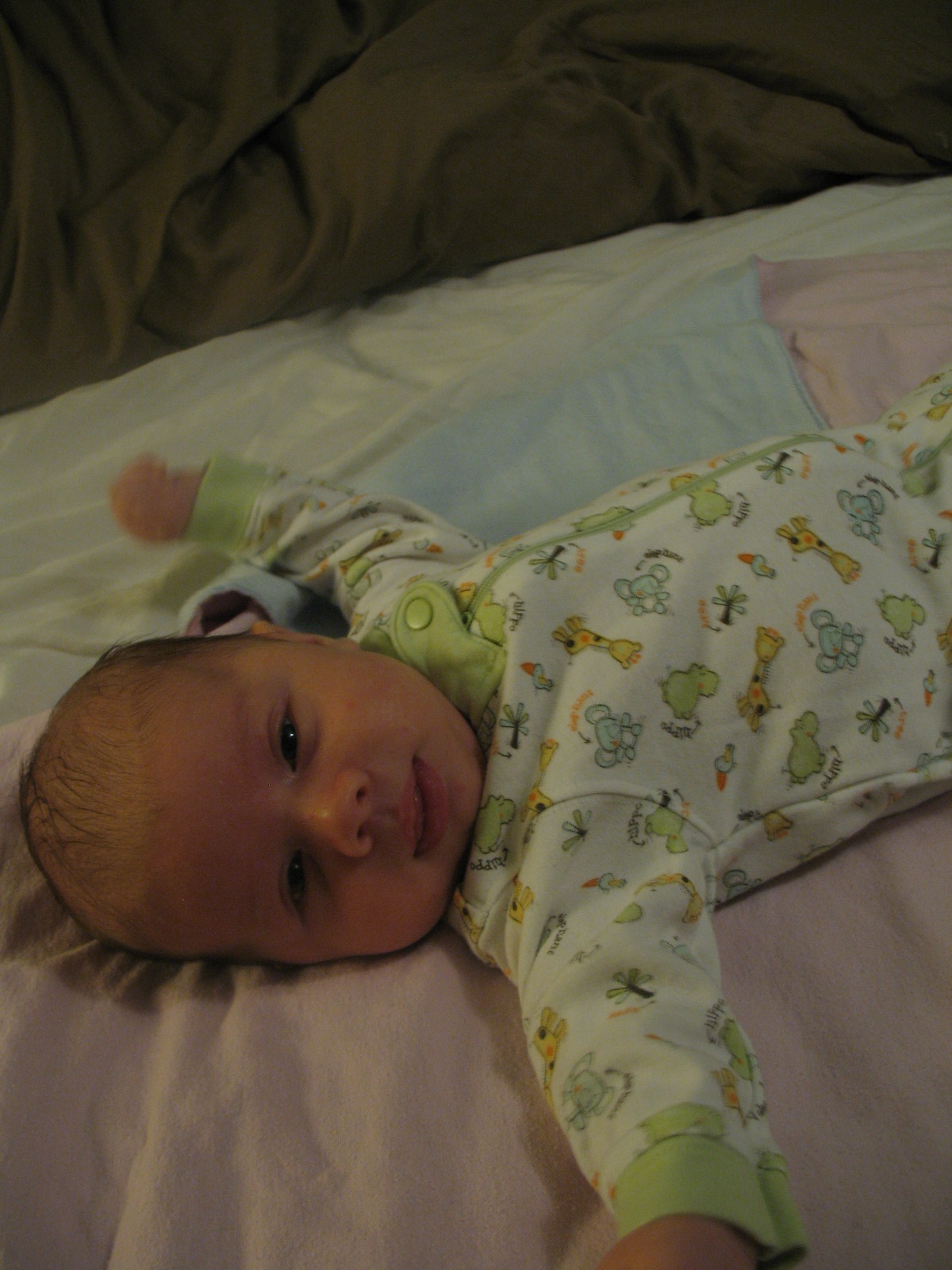
Our RRBB turned three months on Saturday, the magic marker, everyone told me, to when things would start to improve. There's just one caveat, he was born a month early so I'm thinking he'll start sleeping more, and the fussiness will calm down somewhere closer to 16 weeks or four months. I didn't think we'd make it this far, let alone still be sane, but he's been so terrific lately, and crying for only about a half-hour every day at different times in the day, that we all feel a bit calmer in the house. He's also doing an awesome job with tummy time as represented in this hilarious photo.
And calm is what I need. My creatinine went back up, and so the SFDD is still back and forth about whether or not to change our treatment. I am so freaked out right now by the disease and by the fact that, while nothing has really changed (the levels are high but not AS high as they were), the disease still seems to be stubbornly trying to kill me. Yet, I feel so much better. That could be accounted by the fact that I'm getting much more sleep these days, though. It's a silent killer, this Wegener's Granulomatosis, and I wish that it would just go away.
It's funny how being home turns your life upside down in a way. I have never figured myself to be a particularly active person -- I like to sit around, watch TV, read, watch movies. But all of that comes from working full time and needing, I suppose, the down time. I never figured that a 50-odd hour work week, plus commute, was really all that much, it was just what you did. And now, I'm not saying that staying home with an infant is easy, far from it, it's the hardest job I've ever had, but it's also boring. The baby isn't boring. He's a fascinating little thing and watching him evolve is one hell of an interesting perspective, a blessing, I know. But your brain, your own brain, kind of goes on hold, and instead of filling up your day with work, with actual things that make a contribution to the world (in my case, it's books, and I love my job), you fill up your day with errands. With all of the things that you had to cram into the weekend because by Monday morning at 730AM, it was up and go back into the routine again.
The RRBB sat in his bouncy chair for over an hour yesterday while I went through his clothes. Consistently amused by a toy giraffe, we read two books, and listened to music. Then, we danced, a little three-month celebration, I suppose. But that's a lot of stimulation for one wee one and that was only one hour. What do you do with the other 23? He sleeps, I read. He eats, I read. He cries, I cuddle. My RRHB cleans the entire house, I manage to vacuum the upstairs and clean the bathroom sink. Because baby fusses, baby sleeps, baby eats, and I read.
Don't get me wrong, I love reading, but I also need a day that's not filled up specifically with errands. And most of them are made up because if we just don't get out of the house, we start to lose our minds. It's funny, compartmentalizing your life into little hour-long blocks (will he sleep longer than an hour this time?) is not conducive to a lot of activities. And the weather isn't helping. We try to take him for a walk every day, despite the bitter cold, despite the fact that people don't shovel, despite the fact that it's mid-January in Toronto, Canada, simply because we are not the homebodies we claim to be. I will do anything to get out of the house these days, healthy or not, and I'm hoping that it's good for the RRBB, because his parents are errand-crazy.
I'm bleary-eyed this morning, cramming blogging into today. I'm trying a new tactic and putting the RRBB right back into his crib the minute he falls asleep if we are home. The sleep book says that he'll sleep better that way but I'm just trying to wean him from the human-couch aspect of our relationship. It doesn't always work. We had a semi-rough night last night, the first in weeks, so one can't really complain, and I've never seen a baby smile so much in my entire life. He's truly a happy little guy, which means, I hope, we're doing something right. Now if only that happiness could calm me down so I'm not always freaking out about my test results and what the doctors are going to say and whether or not I'll have to change medications and whether or not my kidneys will survive and whether or not the preeclampsia will ever go away and whether or not the prednisone crazies will kick in and whether or not my blood pressure will stablize and whether or not I'll be able to fill up another week with errands. And I feel like I'm wasting this time, which makes me resent the disease even more, it's holding me back from all kinds of things. I can't see the positives today, perhaps that's what boredom does to you, in a way, it pulls you down in ways that you don't want to go, makes you imagine the worst, refuses to give into the calm that you need to badly to get better.
So, errands, made up stuff that isn't remotely necessary to your life, but gets you through the days, pushes you forward without actually accomplishing anything major. I suppose, if you had enough errands, and the ability to focus for longer than a half-hour because of sheer exhaustion, you could manage a to-do list or two. Maybe that's the solution. Putting the errands on a master list just so I feel like I'm spending days living instead of dying (sic, The Shawshank Redemption).
Yesterday, I just had to dance with the RRBB to The Pogues' song A Rainy Night in Soho. I'm not going to lie, I had his little hand in mind and we were waltzing around his room, singing these words in particular: "You're the measure of my dreams, the measure of my dreams." I cried, which is something I do a lot, and then remembered what my RRHB said when I told him about the test results bumping back up -- that it's not getting worse so why freak out just yet, everything is exactly the same, even if it's not terrific, at least it's not as bad as it could be, and the RRBB is certainly the measure of my dreams these errand-filled days.
Tuesday, January 18, 2011
#5 - Abide with Me
 Elizabeth Strout is the kind of writer whose novels have such a solid moral core that you don't even realize their depth until you're at the end, teary-eyed, and wondering how she managed to be so subtle in her prose, yet so overwhelmingly apparent in her themes both at the same time. But wait, let me back up a little. There's a subset of American fiction, primarily written by literary writers, people like Strout and Marilynne Robinson, that I would equate to the "old woman on her deathbed" narrative that sometimes defines our Canadian canon, and that's the "pastor going through crisis" trope (would we call it a trope? Do I even remember what that word means?) that you find in novels like Home or Gilead. So, when I first started Abide with Me, I thought, 'oh, here we go, Strout's just putting in her two cents worth in terms of that American tradition.'
But what a rich tradition it is, and what a rich novel Abide with Me turned out to be. The story of a widower who is the minister of a small town in New England where the rustic setting not only traps its inhabitants during the long, cold winter, it turns them, often, against one another through fits of gossip, jealousy and petty indiscriminations. Tyler Caskey arrives young, bright-eyed and newly married. His wife, Lauren, is almost too big for the town with her bushels of red hair and big city ways. She spends too much money and isn't all that interested in being a minister's wife. Not to mention the fact that the town isn't all that crazy about her, either. But then, she dies a horrible, tragic death (and I'm not spoiling anything here), and Tyler's lost his way, and the novel turns -- it becomes about grieving, about loss, about life after tragedy, and the subtle ways Strout moves through Tyler's experience don't even become readily apparent until the end of the novel, when you fully understand how hard it must have been for him to lose the woman he loved, but also the life he expected to lead.
Not only is Tyler suffering from the loss of his wife, but it seems everyone else in town has undergone some sort of trouble. From adultery to actual crimes, Strout's novel pits the concept of grief up against some very real problems that exist within the human condition, perhaps to explore how grief affects people in many different ways, that it comes in many different forms. By the end, the book moves into a separate stage, and it is through the idea of healing, whether it's by telling the truth finally, by allowing yourself to be forgiven, or by respecting the fact that sometimes you simply can't continue, the entire town can't help but move through Tyler's grief with him, and it has a very poignant impact on everyone.
I adored this novel. I was so taken by the character of Katherine, Tyler's five-year-old daughter, who so vicerally experiences her mother's death that my heart broke on every page, and the sheer inability for the people around her to see how and why she's suffering (with the exception of her father who, while baffled by his daughter's behaviour, clearly loves her more than life itself) or to give her the hand she needs felt so real to me, primarily because I too lost my mother, but not at such a young age. All in all, the novel, set in the 1950s, explores gender roles, explores the banality of small-town life, the suffication of spending so much time indoors when the snow is piled high and all the women can do is make beds and polish floors to keep themselves sane, and it also explores the idea of faith, how it can stretch and bend, but also break, just at the very moment when you need it the most -- and this is a theme for which I am quite familiar with in my own life these days.
I'm amazed that I had these novels just sitting collecting dust for so long. But I am a true believer in fate when it comes to reading. You pick up a book at the right time for you to be reading that book -- if you don't finish, it's not always the book's fault, it's just perhaps not the right moment to be reading. I needed both Amy and Isabelle and Abide with Me this month. They have enriched my life in ways that I find hard to express -- and given me something to aspire to, Strout's writing is simple exquisite.
READING CHALLENGES: Off the Shelf.
Monday, January 17, 2011
Notes From A House Frau VIII
 I realize this photo is sideways, but that's kind of how I'm feeling these days. Not upside down any longer, which is a good thing, but not wholly myself either. We've had an exciting couple of weeks -- we've been getting out a whole lot, we've started to see the world from the squished up view of the Baby Bjorn, which is far, far easier in this weather than the stroller, we've gone skating two Sundays in a row, and out for dinner a whole bunch. We've still got a wee bit of the Witching Hour (last night he cried for a record ten minutes) but we've collapsed entirely into "Accidental Parenting" as The Baby Whisperer (suck it) would say.
Instead of doing our sleep training, which equals us going upstairs and having a bath at seven and then spending two-to-three hours trying to get the RRBB to sleep, we're watching movies with him sleeping on us until he's almost blacked out, and then depositing him in bed. The result? He sleeps for almost four hours at first, then three, then three, and I feel like a human being in the morning. Also, he doesn't wail for the entire time we're trying to get him down. My thoughts? He's just not ready yet. And I'm okay with that. So far we've watched: The Fighter, True Grit, Black Swan and tonight's The Social Network. Please don't ask how we're seeing these films. It's not pretty.
It's funny how much I hate taking pictures of myself when I'm in the throws of the disease. I don't feel like myself and I don't look like myself. The prednisone makes you puffy, it makes your skin all mottled, and bucket loads of your hair falls out. I don't know if I've written this before but way back when I was first diagnosed with the disease, my family doctor said, "What a shame it had to happen to such a pretty girl." As if forever setting up the dichotomy between a healthy, attractive me and an ugly, diseased me. The distinction exists so clearly in my mind that it's hard sometimes to forget about it -- you can avoid mirrors, you can put on some makeup, you can cut your hair (or, in my case, keep saying you're going to cut your hair and never make an appointment because, well, that's a long three hours to spend away from the RRBB), but you can't avoid the side effects.
In a way, side effects are like so much in life, something you need to get through before life gets better, like the Witching Hour. But the manifestation of looking so terrible, the very real implications of the disease, well, those are harder to reconcile when you've been undergoing treatment for so long. And, truly, I haven't even been recovering for that long -- just 14 weeks, like I keep saying, I was the sickest I've ever been in my life, and it's going to take longer than 3 months to get better. Getting better isn't the point, either, staying better is, making sure that I am calm and collected, and truly healed, to get to healthy like I was before I got pregnant. One of the things that's helping is getting out of the house. You start to go completely stir crazy even though it's wonderful to have the RRBB, sometimes you just need to strap him into something and put one foot in front of the other. There's an amazing rail path by our house that we've been walking lately. Lots of wild grasses, snow, and birds, plenty of people walking their dogs as well, and we can walk and talk, and walk and talk, it's very therapeutic.
In addition to walking, I've signed up for Restorative Yoga once a week. It's so expensive but so necessary. I feel so much better after I am done, and it's just an hour, but I also experience how completely broken my body is too. My breathing especially -- the disease has tuckered me out this time, and even though I can barely do anything, and feel like I'm starting from scratch with my practice, bawling each time I'm there, I know it's doing me a world of good. I am consistently amazed at how much pure trauma the body holds separate from the mind, again with the dichotomies, and pulling them both together, like balancing what I'd like to look like with the necessity of the side effects, is an ongoing process. Sometimes you just need to give in to the moment, perhaps that's my lesson for the week, you need to abandon what the books say and just do what instinctively feels right, what works, accidental or not.
Sometimes accidents, biology, sperm meeting egg on a snowy day in February in New York City, are just about the best things to happen in your life. We should remember that lesson always and not define yourself by the tragedy that sometimes accompanies the figurative car crash but what the end result might be -- a brand new life that comes with its own way of expanding your heart in ways that you never thought possible. It's not like I can't teach myself to breath again, it's not like I'm going to forget how, I just need a bit more practice. Luckily, I've got a year to figure it all out, moment by moment, and minute by minute, and as long as I can keep my fingers moving, everything will be okay. For the first time in a long time, I feel positive that I'm actually going to get better, that there's a light at the end of the tunnel, but I don't want to jinx it -- for now, I'm just going to say that even if I don't look like myself, there's a tiny glimmer of feeling like myself, which, in my mind, might actually be better.
#4 - The Keep
 For the most part, I enjoyed Jennifer Egan's The Keep. While I found her writing to be a little commonplace for lack of a better word, I did enjoy the story. In a lot of ways, this novel reminded me of The Ruins, only with stranger characters. The book opens up with a fairly typical urbanite, Danny (an overgrown connected club kid, right down to the earrings and pointy boots), making the pilgrimage to his cousin's castle. Howard, said cousin, has bought the entire German estate, including an ancient keep with its resident, an equally ancient member of the originating family who refuses to leave, and intends to renovate it as a resort -- one free of all modern communication, a place to reflect and unwind, only it's in ruins at the moment. Howard has asked Danny to come and help, and as a 36-year-old with no prospects, he comes as called.
Only there's a history between them. An incident. One that has rocked their relationship, and one that they need to work out as the story progresses. I am not going to spoil that here. What I will say is that alternating between the chapters where Danny finds himself in increasingly dangerous and injurious situations, you discover the novel's actual narrator, Ray. He's a prison inmate taking a creative writing class, and the story of the castle, of the keep, and of Howard and Danny, is actually his project. Teaching the class is Ann, and a strange, Shawshank-like relationship rears up between the two.
For a while, you wonder how it all relates: where does Ray's story come from, how does it all tie in together, and then Egan pulls out the twist, and the book changes perspectives. We're now looking at things from Ann's point of view, and this was the part of the book that I actually found the most intriguing. A former crystal meth addict, whose husband is still addicted, Ann is trying desperately to be a good mother to her two daughters, both of whom were subjected to their parents' awful behaviour.
Many of the characters feel cookie-cutter, like you could have pulled them from a bag of stereotypical characters from pop culture -- even Ann, "drug addicted mother" and Ray "far-too smart criminal," are a little too cookie cutter for my taste. But as far as a good commercial read goes, you don't get better than The Keep. It's creepy in all the right places but, like The Ruins, the true terror factor doesn't leap off the page as one would hope. There's one absolutely terrifying situation but I was constantly questioning the believability of the whole story throughout. Yet, I did find myself drawn to Ann, and to her vulnerability, and that's probably why I wished there were more from her perspective than just the last section of the novel. But I'm a sucker for hard-luck addict stories, hell, that's why I loved Lullabies for Little Criminals so much.
On the whole, I was terrifically creeped out by The Keep and found it a solid read, especially following The Guardians. Maybe January is the perfect month to read terrifically spooky books -- it's all dark, cold and snowy, and the nights seem to last forever, especially when you're up at odd hours like 2 AM, 4 AM, etc. But does this novel put me on a crash course to read every else Egan has ever written, not really. Certainly not like Amy and Isabelle by Elizabeth Strout, which is why I'm halfway through Abide With Me at the moment. I'm hoping to finish it today because I have so much to say about it already -- the blog post is active in my mind. Now finding time to read and then write it all up, well that's an entirely different story.
READING CHALLENGES: Off the Shelf, of course. I'm getting tired of writing that sentence. I am not, however, getting tired of cleaning off my shelves. Now we just need more visitors who like to read so they can pick over my outgoing box of books so the novels can actually leave the house and be enjoyed by someone else!
Tuesday, January 11, 2011
#2 - The Guardians & #3 - Making Light of Tragedy
 A friend at Doubleday sent me a galley for Andrew Pyper's The Guardians way back in the way back, and then asked that I not post until closer to the book's pub date, which was the beginning of the month, I think. Regardless, I put the book on my shelf and forgot about it until one day last week when I was searching around for something BETTER to read than the Joyce Maynard I had just finished. I described the book on Twitter as such: "The Guardians = Stand By Me + River's Edge / Mystic River without the Boston setting."
And I stand by these comps. The book, about a group of hockey-playing young men, friends since grade school, who end up embroiled in a tragic situation involving their hockey coach, a young woman and a haunted house, was seriously not what I expected. As you know, I have little faith in "haunted" stories. Blame my reticence on Sarah Waters, I think The Little Stranger ruined it for me forever, and maybe it's because I don't think any book can do "haunting" better than that Alejandro Amenábar film, The Others, I've given up finding satisfaction in being scared in print. Also, I really hate being scared so why would I put myself through days of it versus 1.5 hours of a film.
Yet, I found myself inexplicably drawn into to Pyper's narrative. He has a cool way with character, they're masculine, very Lehane-esque, but that's not off putting to me as a female reader. The main character, Trevor, suffers from Parkinson's, which, while the disease isn't remotely the same as mine, I can kind of relate to -- simply the idea of your body not cooperating with itself. When his childhood friend commits suicide after years of protecting both the secret the group of four boys harbours and the house across the street (the haunted house), Trevor and Randy (the second of the foursome) head home for the funeral. The truth unravels from there, and I didn't even mind the "memory diary" device that Pyper uses (Trevor's therapist insists he keep it as a way of dealing with the disease; should my shrink ever do such a thing I would terminate treatment immediately; who wants to be constantly reminded of what the farking disease has taken away from you, seriously?). The narrative switches back and forth between Trevor's diary and the action in the present tense.
There are all kinds of interesting things that happen when someone goes home, especially someone who made the conscious choice, after the tragedy, that Trevor did to never go back. The small-town Ontario setting adds to the nuance of the novel -- things like this couldn't happen in a big city, someone would tear the house down, raze the trouble before it even started or simply not notice, walk on by. But in this town, a hockey town, the house stands for over forty (I think) years creating havoc for not only the four boys who are deliciously intertwined in its grasp, but a few other tragic souls as well. It's a terrific book, a perfect read for a snow day if there ever was one, and I'm glad that I read it in the deep, deep hours of the night, just for those extra chills.
The other title I read last week was Jessica Grant's Making Light of Tragedy for my book club. The cover sucks so I am refusing to put it up here on the blog, and Kerry's done a wonderful job of wrapping up our meeting. Everything she says about the book, well, that's what I think about the book too. I fell on the Grant's writing was a little bit too twee for my liking, and kept thinking of that old-school writing class line that if you're in love with your prose that's the stuff that should be cut right away, and there were many, many, many loved lines in these stories that could have been sliced to the benefit of the writing. However, there were also some amazing metaphors -- and this coming from a girl who actively removes every single metaphor from her own writing she finds them so distracting -- where I found my breath catching just a bit at her turn of phrase it was so beautiful. So, uneven, but enjoyable. The company, however, and our meeting, was a serious breath of fresh air. I even managed to feel like I was using a part of my brain that a) doesn't sing everything I'm doing, b) actually considers thoughts before they come out of my mouth, and c) had nothing to do with talking to or about the RRBB.
WHAT'S UP NEXT: I'm reading The Keep right now, as recommended by a few friends, but am actually spending far too much time playing iPad Scrabble during the late-night feedings. It's scrambling my brain a little so I am going to stick to just the book tonight, we'll see how that goes at 2 AM.
Monday, January 03, 2011
Notes From A House Frau VII
 RRBB's First Toque: O, Sweet Child Of Mine.
I am a woman who loves a toque. I wear them all the time, who cares if I look like Jay of Jay and Silent Bob, I love them. And, I am instilling this very real, very Canadian love on my child. This toque is a present from his Grantie Judy. And it's awesome. Although I am afraid he'll out grow it before too long and then I might have to frame it. Along with his umbilical cord stump and my pregnancy test. Is that weird to want to frame all that stuff and put it on my walls? I don't think so, but someone might.
We aren't sure if we are through the rough patch yet. Starting on Christmas, as I said, RRBB went through a period of intense fussiness at bedtime. It was almost too much to stand. A friend said, "Oh, yes, you think it's done and then they break you." And she was right. On New Year's Eve, instead of starting at 830 or so, RRBB decided to start his fussing at 11 PM and go right until 4 AM. And we are now in week three or so of this phase. Everyone says that it'll calm down around three months, but counting from his due date, that's another five weeks or so. We can do it right? If people can climb Mount Everest, my RRHB and I can cope with a crying baby. The whole concept of The Witching Hour is fascinating -- that his little brain/body is working so hard to grow at such a furious pace that it simply can't contain itself -- that it almost makes up for how rough the few evening hours are.
Luckily, he's an utter delight during the day for the most part, and is a great napper. We take amazing walks along the rail path by our house, and he doesn't mind at all being in the stroller (once he's in and outside). We've even managed to go out for dinner twice, and tomorrow I think, if I am not so diseased, we might go to a Mommy and Me movie. Maybe. That might be pushing it. All in all, there's little bits of life coming back into my life these days -- I am clinging to them. He's smiling a tonne, is awake and alert more, and is starting to really recognize us. But what I've been thinking all along is how different the idea of parenthood has always been for me, for someone who always imagined it was out of reach because of the disease and other factors, from the reality. The emotions are so much more intense in both directions. I never imagined I'd miss myself so much. Hell, I spent x-number of years hating myself intensely, why would I miss myself? But I do, and just those little bits of me coming back, along with some better test results from my blood work lately, I'm starting to see the light at the end of the tunnel.
So, we might be a bit behind in terms of birth date/due date, and it might take a few more weeks of losing our evenings entirely to a wailing child, but by the summer, hell, by the spring, I think we'll be in a much better place. I'm even feeling confident they won't switch the drugs over... but we'll see about that because I'm still having disease symptoms three months into treatment. I wish I wasn't puffy. I wish my hair wasn't falling out. I wish I wasn't eating terrible predisone-induced food. I wish the baby wasn't fussy. I wish we weren't so broke. But I don't at all wish for anything to be different because I am content in a way that I never knew possible. Things are miserable with my health, worse than ever, but I made it through, and sometimes being tough is just the point. Maybe there's nothing else to it -- and that's what almost three weeks of fussy baby is pointing us too as well. You can battle it all with a good sense of humour, an awesome RRHB, and some really, really good drugs. But being tough, being strong, being someone who survives, these are not poor qualities to have, are they?
Sunday, January 02, 2011
#1 - The Good Daughters
 Sometimes it's hard for me, professionally, even though I know this is a blog for which I am not getting paid, to separate my true feelings about a book from a more balanced approach in terms of reviewing. Joyce Maynard's The Good Daughters puts me once again within this dilemma. Other aspects conflicting my ability to write a non-biased review: I have met and interviewed the author, and was incredibly inspired by her; and I loved her previous novel, Labour Day.
But that doesn't take away from the fact that there is something definitively lacking within this book. If I had to put a finger on it -- and this may seem harsh -- it's story. Told from the alternating perspectives of two "birthday sisters" born on the same day in a small rural community in New Hampshire, the book feels more like a character study than a novel, and it lacks a certain polish. The writing is often redundant and repetitive, parts that could be interesting are told in shorthand in the rush, I suppose, to get through the entirety of each woman's life. The book skims the surface and uses cliche to describe key elements (no woman should ever be described as a rare fruit, like, ever) and the constant back and forth feels gimmicky.
It's obvious that there's more to the story than the fact that the two girls, Ruth Plank, a farmer's daughter, so inherently different from the rest of her family, not just physiologically but also emotionally, and Dana Dickerson, stuck with parents who never should have been so, awkward and incredibly different than her flighty family, were both born on the same day in the same hospital nine months after a terrible hurricane (yes, a hurricane, boy it does stir up some awful human emotions and some truly interesting mischief, yawn). And, not to brag, but I had figured out the "twist" by about page two and then had to read on until the big reveal -- Maynard parsing out little clues here and there throughout. What's most astonishing is that both Ruth and Dana, intelligent, well-adjusted women both, didn't give more thought to how different they are, to the real story, before just about everyone around them who knew the truth ended up dead.
There's a sweetness to the novels that you can't deny, and I think it would make a very good book for, forgive me, suburban mom book clubs. But it really wasn't a book for me -- a quick read, which I always appreciate, with a really great setting (I love the Plank farm; its history and its roots [been in the family for 10 generations]) and I can see what Maynard was trying to do but I always find that books that try to encompass so much, like entire lives instead of those pivotal moments, sometimes lack the depth that I crave in a more literary sense. Yet, the stereotypes and the coincidences are a little too much to take in places -- I appreciate Maynard's inclusive writing, international adoption, a truly beautiful lesbian partnership, are just two examples, but when it all comes together it feels forced, a little too Jodi Picoult movie-of-the-week for my tastes.
Overall, I was disappointed in this book, and I hate to start off a reading year on such a note, but there's always tonight for another try. I'm not sure where I'll go next. There are so many books to choose from. What I'd really like to know is what everyone else is reading and have some recommendations. I'm pretty sure I'll be able to find one or two titles on my shelves.
Saturday, January 01, 2011
New Year's Revolutions 2011
 We had a bit of rocky start to the New Year. RRBB fussed until about 4 AM so there was a lot of up and down last night. I haven't given the same kind of thought to my New Year's Revolutions as I normally do -- I honestly take the week between Christmas and New Year to reflect on my year and to read as much as possible. At least I'm still accomplishing the latter.
To review: New Year's Revolutions 2006, 2007, 2008, 2009 and 2010
I did really well compared to last year: I kept the weight off, exercised regularly, even during pregnancy (swimming at lunches at work), spent a lot of time at the cottage, and even managed to get my book out into the world (it was rejected; but that's okay). Instead of the more philosophical goals I generally set out to accomplish, I am taking a slightly different stance this year.
1. Be Well
This means doing everything I can to fight the disease whether it's taking my meds, adjusting to the new course of treatment, taking restorative yoga, going for walks with the RRBB, or simply accepting the fact that I am very sick right now and the most important thing is to get better. I have too much to lose otherwise. But it also means being well in my mind. I have a lot of work to do still in terms of accepting everything that happened over the last few months: I still haven't forgiven myself for letting the disease get so out of control. I know technically it's not my fault but I could have been more aggressive in letting the doctors know exactly how I was feeling or being more persistent in terms of my own care. I was just so happy to be having the baby -- I got cocky.
2. Write
Any words, in any place, in sentences or just in thoughts. I just need to keep going. Between the disease and the RRBB, I have lost myself entirely. This wasn't something I was expecting with motherhood. The sea shift in terms of where my attention needs to be. There's nothing wrong with an old fashioned pencil and paper in a cafe. That's something I can do during the week with the RRBB. He does love his walks. Winter be damned.
3. Be a Better Friend
People were so very, very good to us during our tragedy. Old friends, new friends, it was amazing the outpouring of goodness. I need to find small ways to give that back -- to let everyone know how much I appreciated it, how special it made us feel.
4. Enjoy Our New Life
This one's easy. It's the simplest thing to do right now. Even when the RRBB is screaming and bawling at 330AM we still love him to bits. He'll work it out. Just seeing my RRHB laugh at him when he's turning purple lightens the stress of the situation. Now, if I could only get some more sleep.
5. Stop Worrying About Money
We aren't going to make very much of it. We are probably going to go into debt. I have to let it go and get through the year. I need my RRHB's support during this time. We need to be together here for the RRBB. Everything else will work itself out.
So, only five -- of course, the usual revolutions are in there -- watch less TV (which I have done in spades, I have barely seen the TV since the RRBB was born), read more (which I've been doing exceptionally well with), make better choices when it comes to the internet (the iPad makes this easy; no more internet coma), and use what we've got, consume less (this might be hard as we are, of course, wanting to do so much with the house this year).
What are your New Year's Revolutions?
Friday, December 31, 2010
#67 - Amy And Isabelle
 After suffering through Pearl, was I ever grateful for Elizabeth Strout's excellent Amy and Isabelle. When I was combing the shelves for something to read, I had forgotten that Strout wrote the excellent Olive Kitteridge, and you can see similar themes in her earlier novel: small town life, history repeating itself, the problems of parenthood, mother-daughter relationships (even though Olive had a son, correct?), so I should say parent/child relationships.
Regardless, Amy and Isabelle remains a thoughtful, engrossing novel that takes place, I think as the 60s are turning into the 70s. Isabelle, the mother, and Amy, the daughter, each live with their own internal restrictions that affect their relationship. Isabelle is strict, complex, sad -- she tells everyone she's a widow, but you know that's not the whole story -- and is in love with her boss at the shoe mill where she works as a secretary. So proper she always wears pantyhose in the heat of summer (the hottest on record), her thin brown hair consistently pulled into a French twist, she's unprepared for the issues that arise over her daughter: typical teenage stuff, lying, inappropriate love affairs, and then a shock that changes everything.
Amy's naive in an intelligent way. She was raised by an honest, forthright person (for the most part) and believes that when someone says something, they mean it. And her good heart, her good nature, gets her into a situation that ultimately disappoints her, it's heartbreaking for both mother and daughter.
Strout has a gift for small town life, like in Olive Kitteridge, she intersperses the story of the main character with other colourful people -- people like Amy's best friend Stacy, her parents, the church women and a truly delightful character called Fat Bev (who comes from French Canadian stock; naturally).
Shirley Falls, Maine might be experiencing a heat wave but the weather isn't the only thing stagnating. As the summer progresses, and as the lies pile up both for Amy and for Isabelle, it's a relief when the truth rains down, both metaphorically and literally -- the storm breaks not just the weather, and it's glorious. The novel itself reads like that moment just after a storm when everything feels fresh and renewed. I honestly enjoyed this novel so much that I spent the few spare minutes finishing it yesterday morning when I should have still been sleeping. I did regret this for a moment when the RRBB had such a rough night last night, but good lord, it was a good read. I honestly think that Alice Munro is an excellent comp for Strout, so if you're a fan, I'd be curious to see what someone else thinks.
READING CHALLENGES: What else? Off the Shelf!
WHAT'S UP NEXT: I started Joyce Maynard's The Good Daughters and am already finding it a bit lacking. The prose feels a little sloppy and repetitious at the moment, but I'm hoping the further I get into the actual story, the more this will abate.
Thursday, December 30, 2010
#66 - Pearl
 Oh, this book. OH THIS BOOK. I wish I had better things to write about Mary Gordon's Pearl. I know how hard it is to write a novel, and I always try to judge books with that thought in mind, but I couldn't get over how annoying I found the narrative voice in this book. Gordon uses the second person, a device that rarely works beyond Choose Your Own Adventure, and the narrator TELLS the entire story. I know it's obnoxious but it's the kind of writing I hate -- the storytelling, the David Adams Richards-esque, perspective that ultimately means that the writer doesn't trust the reader to GET it.
 Pearl, the title character, is a, natch, beautiful young woman in her twenties; she's impressionable but brilliant at languages, so she's studying Irish in Ireland in the 1990s. Taking a very tragic accident to heart, she chains herself to the American embassy after putting herself on a hunger strike for six weeks. She's going to die for a cause -- in a roundabout way, the Peace accord that Sinn Fein signed -- and feels her actions are right and just. Her mother, Maria, a strong-minded, strong-willed woman who came of age in the 60s, flies to Ireland to try and save her daughter's life.
The premise feels so forced, in fact, the melodrama of the entire story degrades the very real politics in the novel. It belittles them to the point that I was a little offended. That Pearl invokes Bobby Sands, that she is so taken by his very real and very necessary actions, isn't what bothered me, what bothered me the most is the arrogant way the narrator speaks from her perspective. It's not that Gordon is a bad writer -- she's just far, far too precious of a writer. It's as if she's in love with every single sentence and doesn't have the heart to cut to the actual story, which, had it been allowed to be shown instead of told, could have been quite affecting.
There's also a moment of such pure absurdity, I mean, eye-rolling absurdity, between Pearl, Maria and Joseph, Maria's quasi-adoptive brother (he's the son of her housekeeper; Maria's mother died when she was two and her father employed Joseph's mother; he became like Maria's brother, caretaker, and so much more), that put the nail in the coffin for this novel for me. I almost didn't finish but I am on a mission and I stuck with it. But I'll tell you one thing -- it's hellish to try and read a book you really aren't liking at 4 AM. On the whole, I didn't find a single part of this book believable, not the characters, not the situation, and especially not the intrusive, annoying, overbearing narrator who just wouldn't remove themselves and let me enjoy the writing. It's the first dud from my shelves. How disappointing, eh?
#65 - Payback
 Margaret Atwood is one of the few authors, Canadian authors, where I've read almost every single thing she's ever written. It's not even a love-hate relationship: I count a few of her books among my absolute favourites (Surfacing), and when I saw her at the IFOA a couple of years ago, it was one of the most entertaining readings I had ever been too. So, I bought Payback, years ago, I think, and it sat on the shelves. Atwood's Massey lecture looks at the philosophical and literary implications of debt -- what it means from a balanced perspective. This isn't a book about the recession or about the failure of our monetary system but it's about what it means to be in debt from a moral perspective.
 I was honestly surprised at how much I enjoyed reading Payback. I actually learned a great deal about the idea of balance. Atwood takes a very thorough look at what defined debt throughout the ages -- starting with early philosophical positions (there's lots of talk of mythology) and ending with a modern-day take on Dickens' character Scrooge (with all of the implications of how we are living today), Atwood's point is simple: we can't keep taking so much without giving something back... and if we don't give it back, the universe will just take it.
Anyway, I don't have much more to say about it -- this is probably my shortest review ever. Balance is good. Taking advantage of our resources isn't. Money is so much more than dollars and cents, and there's a surprising amount of debt in literature. If I ever go back to grad school, what a fascinating thesis that would make.
READING CHALLENGES: Off the Shelf, naturally.
Notes From A House Frau VI
 The Calm Before The Storm.
Oh, the baby book warned us. We were told that six weeks beyond RRBB's due date of November 19th he would hit his fussiest period yet, and they weren't joking. Between his first shots, the fact that he just can't seem to get to sleep at night despite being so tired his face looks like he just went twelve rounds with Ali, and then that whole holiday insanity, it's been a hellish ten days. He's sleeping right now but chances are I'll have about fifteen spare minutes because he already looks like he's waking up.
The adjustment to motherhood hasn't been an easy one. I think even having a spare hour to myself would help at this stage but the baby's not in a place to give that to me at the moment. Then, we need patience. But we've talked about that before. That's not a new lesson. I am constantly thinking and rethinking my approach to everything. Consistently questioning and requestioning my decisions in terms of his care. It's a guessing game most days and I'm waiting for the answers to present themselves.
There's a lot of introspection that goes on when you spend so much time with a little person who can't communicate back to you. And when you mix in the life-threatening disease stuff happening, I spend a lot of my interior life contemplating how I want to live, what I want this all to really look like, and then being utterly unable to put my thoughts into action. Not for lack of trying but for lack of energy -- and I know recovery, especially from a flare as serious as the one that I had, will take some time -- I keep expecting myself to be back to normal. It's been twelve weeks now since I started coughing up that blood, and I had hoped that things would have turned around by now. But I need to keep my expectations in line with my actual health. Being sick is so hard for me to take -- it sits at direct odds with my personality.
I also keep overestimating what I can get done in a day, both with the RRBB and with my health. I spend a lot of time worrying about things: about money, especially. We don't have enough at the moment. That is a fact, UI barely covers our mortgage payment in a month. The downside of loving to manage money would have to be the insane spreadsheets and complex accounting that I tend to do during times of stress. I mean, truly, I have an awesome spreadsheet that keeps track of our spending, which is totally out of control at the moment. You see, the other downside to being home all the time? We really want to get the house into a finished, final, state. We bought some art -- two beautiful paintings by Toronto artist Matt James -- we bought a chalkboard for the kitchen, we put up the posters we got framed earlier in the year, and my RRHB finally hung up my garage sale finds in my office. The house looks great. And then Christmas came. So we are a little behind. So, late one night when the baby was feeding, I bought Gail's latest book, Never Too Late, and read it on my iPad (#64), because I needed to feel like I had at least a little bit of control over what's happening in my life right now. As you know, that generally only comes from reading. The book is mainly about saving for retirement, which I've been doing since I was in university (I used most of those savings to buy our house; and have continued to build our RRSPs up over the subsequent years), but there are some great management tips in there too. However, the main thing I realized was that using our Emergency Fund, which is quite healthy, over the next few months is exactly what it's for -- I am sick. I need help. Even though it would be better for my RRHB to work when and if he can, what's better for our family is to have him home helping me, helping us, and just being with us. The most important thing in my life right now is getting better so I can be the kind of mother I imagine in my head, and to get back to being myself a little too.
Anyway, Gail has some great tips -- putting away the dollars you save by using coupons in a vacation fund, or just using it for savings. Her whole point is that it isn't hard to save, it just takes a change of mind. Oddly, that's what all of these quasi columns are about for me, learning how to change my mind as my life changes. There's a constant evolution that takes place on a day-to-day basis when it comes to the baby but also when it comes to us as people. The change might be dramatic at first: you stop working, you spend all your time at home, you almost die for the third or forth time in your life, you are taking bucketloads of medicine, and normalcy becomes relative. It's as if it shifts like time does when you have an infant: there's very little difference between night and day. That's why I'm clinging to certain things, repeated again, reading, writing, thinking, and hoping. I know I am watching way too much Oprah but trying to be in every moment is actually quite entertaining. Last night, our little RRBB was throwing him umpteenth fit and we were just laughing with each other... trying to calm him down, obviously, cuddling him, rocking him, kissing him, but also laughing because he's so damn cute when he gets that upset. If we can hang on to that manic happiness, I know everything will be okay. Love is a pretty magical thing, and I'm not just saying that because I'm feeling weepy and a little introspective because it's the end of the year.
We have two more weeks until he's three months, then another four after that until he hits his due date "three months" so we'll see how things go until then. Everyone keeps telling us that it gets better but maybe it getting better isn't the point. Experiencing it is. Looking at what we can learn from his point of view, however undeveloped that might be, and knowing that "unexplained fussiness" might just be the death of us, it's just a stage like so many other parts of life. Our biggest success today? We left the house for a walk, and it was a gorgeous day.
Monday, December 20, 2010
#63 - Moonlight Mile
 Murderous Christmas continues, and I finished Dennis Lehane's Moonlight Mile in record time. I read about three pages last night before crashing into sleep and then, in between visits to the hospital (blood work), visits from my Aunties, and a trip to the Duff, I finished the book about three minutes ago waiting for the baby to go to sleep. The book picks up twelve years after Gone, Baby, Gone, the other other Patrick and Angie book I've read (which I enjoyed immensely), and a lot has happened. Patrick and Angie are back together, they have a daughter, and they're once again hired by Bea to find Amanda McCready, who has once again disappeared.
Nothing is at it seems, of course, and Patrick finds himself stuck in this case that, like all those years ago, puts his life on the line and then changes it forever. I can totally see what Sarah Weinman was talking about in her review of the novel, but I didn't read and/or experience a love for crime fiction in the same way, so I don't have the same expectations. The book gripped me from the beginning, and not just because the characters are terrific, but more because the story just dove right into the action. Then, it doesn't let you go. I appreciate a good, plot-driven novel. I mean, I am a snob, don't get me wrong, and years ago, if someone told me I'd be reading bucketloads of mystery/crime novels after giving birth, I would have laughed and said something obnoxious.
There are flaws with Lehane's writing, don't get me wrong. I'm not convinced that every single character needs their hair described in such immaculate detail but, in the end, it doesn't matter because the story itself flies off the page -- and once you pick up the book, you seem to get to the end before you even realize it. I guess you have to forgive him for these petty details, for the odd over-description and the sometimes melodramatic sentences, because he writes great dialogue and has created such a hard-driving narrative. It's immaculate commercial fiction and that's a hard balance to strike -- it satisfies literary snobs like me and more general readers in one fell swoop. That's not something to be overlooked or under appreciated.
Many of my co-workers tell me that the entire series is just that good. Maybe I'll go back and read more than just the two I have done, but I'm satisfied with my Lehane experience. Maybe I don't want to ruin it. I'll just leave it where it is for now. So, no reading challenges accomplished with this novel, but that's okay too, right?
Sunday, December 19, 2010
Notes From A House Frau V
 He's a little blurry but our RRBB has started smiling. It's pretty terrific to see him open up like that and it makes us both a little giddy. It's been a hard few days. The SFDD has decided for us to stay the course -- I am taking more meds, but they are the same meds, so we can keep breast feeding for now. As I'm still having disease symptoms, they are slight, but they are there, and that means that chances are we'll be taking the "big guns" meds in January to try, yet again, to calm the storm. The disease is a light rain at the moment; they want to completely clear up the clouds, bring on the sunshine, but because the weather system inside my body remains so severe, it's touch and go until the drugs start to work.
 What all of this means for me -- being stable but on the edge -- is more blood work, heading to the hospital every 10 days, more doctors appointments and lots of careful monitoring. But, we get to breast feed. I think the sacrifice is worth it. I'd rather give him three months than two, but I also don't want to be on dialysis in six months either. The thought terrifies me. And my lesson for this week?
Irony.
Funnily enough, the first thing that happens when you become a parent, regardless of how old you are, how far along in your life, people come forward with advice. This doesn't bother me in the slightest, I am a big giver of advice, so you can't be obnoxious about receiving it (and I can't remember if I've talked about this before), and the #1 thing that everyone tells you: rest, rest, rest. It works both with the Sickness and with the Newborn. Yet, the prednisone makes you so wired -- it's kind of like being on speed (not that I've done speed; I'm extrapolating) -- that it's impossible to rest. The drug keeps you awake all the time. The RRBB keeps you awake the rest of the time. This means that I am wiggy with lack of rest, my body under siege and no release on the horizon. Some days I kind of feel like that boat in that George Clooney movie (I know, it's not very good, The Perfect Storm). Right now, I'm Marky Mark floating on the horizon. In my case, I know I'll be rescued. I'm not going to drown but getting through the irony of having to rest but being physically unable to do so because of the very drugs that are meant to keep me alive, well, it's an interesting conundrum.
I've signed up for Restorative Yoga in January. I'm going to do private lessons. They will be expensive, and I know Gail Vaz-Oxlade wouldn't approve, but I need to heal and it's one way that I know works for me. I'm also keeping the crazies at bay by making lists and trying to cross things off one-by-one. It's a recurring theme for me -- trying to get a handle on the psychological side effects of the disease by doing small things that I actually do control -- and it's the first thing that gets out of hand when the psychosis hits. Thankfully, and I don't know quite why, but I am thankfully free of this side effect this time around. That's not to say that I don't break down every few days, bawling, and I know it's because I'm just so bloody tired but, on the whole, I am not wanting to drive my car into oncoming traffic (that's what happened the first time I became sick) or jump off the top of a tall building (which happened the next time I took this much prednisone).
Laying it all out, the rareness of the disease means that I am a bit of a science experiment for my doctors. It's always worked well for me in the past, and patience to truly wait for everything to calm down is needed. I'm finding that in books right now. I'm finding that in little moments here and there, writing here. Truly, as long as I keep putting the words down, taking them from my brain and putting them out there, I can keep a little bit of myself back from the disease. It doesn't get to own all of me. Even if it feels that way a lot of the time.
#62 - Calling Out For You!
 When I was babbling on about all of the Scandinavian mysteries I've been reading lately, Melanie, over at Indextrious Reader, tweeted about her favourite, Karin Fossum. So I scanned my shelves and happily discovered I had an Inspector Sejer mystery, Calling Out For You! at the ready. I might as well call this my Mystery Christmas for all novels in this genre I've been reading, and I'm pleased that I can cross Norway off my Around the World in 52 Books challenge with Fossum as well, and the translation by Charlotte Barslund is one of the better that I've read -- far less clunky than all of The Girl With novels and, on the whole, Fossum's a much more skillful novelist than Camilla Lackberg.
Calling Out For You! (the exclamation point seems a bit, well, tedious) finds Inspector Sejer solving a heinous crime involving the brutal murder of an Indian woman, the newlywed wife of a middle-aged farm equipment salesmen who was truly looking forward to welcoming his wife to his country, his home. Gunder Jomann, quiet, reserved, lonely, takes the biggest risk of his entire life and simply decides to go to India. Upon his return, the very day his new wife Poona was set to arrive, his only sister ends up in a terrible car accident and he can't collect her from the airport. Tragedy ensues -- Poona doesn't arrive. Instead, she's found bludgeoned to death in a field outside of town.
Fossum's careful not to lead you entirely in the right or wrong direction. There's a mystery to the mystery -- who actually killed Poona and why -- that's inferred but not entirely delineated by the end of the novel. It's a character-driven book, you feel emotionally connected to the Gunder, the distraught, decent man who ultimately suffers unspeakable tragedy. And the detective work is straightforward, simple, to the point. There isn't the driving plot that you'd find in the The Girl With books, but that's okay, there's a decency to Fossum's characters that's very real. Setting doesn't play as an important part in this book the other mysteries I've read by authors from this part of the world (that was the only thing I truly enjoyed about The Ice Princess). But you get the small-town, everyone-knows-everyone, feeling throughout the novel, which always contributes to the shocking nature of the crime.
I flew through this novel, primarily because I truly, honestly wanted to know who did it -- and it was VERY hard not to cheat. Ever since I was a little girl, I've read the last page of the book sometimes even before the first and it's an especially hard habit to break with mysteries. I don't want to spoil it but then I absolutely just have to know. In this case, I managed to be patient, but mainly because it was such an easy read, and didn't take too long to get to the end. Any longer and I wouldn't have been able to stand it.
READING CHALLENGES: Around the World in 52 Books and The Off The Shelf Challenge. Two birds with one book, yet again.
WHAT'S UP NEXT: I can't decide: AS Byatt or Dennis Lehane. I suppose it'll be up to what concentration levels I can manage this evening upon retiring for the long, long night as the RRBB eats, sleeps, eats, sleeps, eats, sleeps.
#61 - Affinity
 In a lot of ways, I am neither here nor there with Sarah Waters. By that I mean, I either really love her books, like Fingersmith and The Night Watch or I really, really don't like them at all like Tipping the Velvet and the incredibly boring (by my estimation only) The Little Stranger, which honestly put me to sleep more than scared the bejeezus out of me, as was probably intended. So, I've had Affinity languishing on my shelves for years. And, at first, I thought it was going to go the way of The Little Stranger, but I actually ended up quite enjoying the novel.
Set in the 1870s in London at the height of the spiritualist craze, the novel's protagonist, Margaret, falls head over heals for an inmate at Millbank prison. Selina's an infamous spiritualist who finds herself in hot water after her patron dies unexpectedly following a fairly intense visit from "beyond." Being the cynic that I am, of course, you know that Margaret's being swindled, but it's a long con, and a devastating one when you look at the novel in terms of options for women, single women, of her class, stature and sexual orientation. So, the harder Margaret falls for Selina, and her impressive parlour tricks, the more you, the reader, realize that it's all going to turn out very, very poorly for the trusting, intelligent, yet wholly gullible girl.
Devastated by the loss of her beloved father, Margaret's an easy target. Set adrift by lack of options, she will neither marry but nor does she want to spend the rest of her life caring for her demanding, controlling and often obnoxious mother. She sees her mother growing older and more demanding, can't bear a life of calling cards and visits, and longs to visit Italy. But the upper middle classes aren't the place for women to go travelling alone, and without a sustainable relationship, Margaret's trapped in her drafty house with only her diary, and her visits to Millbank prison, to keep her sane.
The novel speeds along and the format suits the subject matter impressively. Interspersed with Margaret's own journal/diary entries, you get more and more backstory from Selina. Are her psychic powers authentic? Can she truly call upon the spirits to come? Or is it all just a ruse? Waters is careful to parcel out the truth and the tricks throughout the narrative in a way that intends to keep one guessing but it's fairly obvious early on what's going to happen. Knowing that Margaret's being duped didn't lessen the impact of the novel but increases the emotional quotient -- you are that much more involved when it gets to the end.
All in all, I am glad I stuck with Affinity through the wee hours. I almost abandoned it halfway through and picked up AS Byatt's latest book, which I am starting this evening. And, it cleared yet another book off my shelves!
Tuesday, December 14, 2010
Notes From A House Frau IV
 Here is baby's first outing to the rink. Yes, the hockey rink. We watched our nephew participate in some faux-Olympics to celebrate the end of his skating lessons and it was just about the cutest thing ever. So much to look forward to, right? RRBB slept through the entire thing, like he does with so much of his life. The odd irony (is it ironic?) of early parenting, how much the baby sleeps vs how little the parents do, his life is so restful when he's not screaming.
 The strange obsessive need to clean up and out continues. I know it's a product of the prednisone crazies, and I know it's from being inside the house so much, I just can't stop thinking about how much more I can tidy up and move around. Of course, most of it is just heading into the basement, but that's the last stop before it's out of the house forever. I can barely believe that Christmas is just about ten days away, and that next Friday is Christmas Eve. I know where the time has gone, and seeing the beautiful snow today made me realize that it is really winter in Toronto. One thing I am grateful for right now: not having to commute everyday downtown. One thing I am not grateful for: it's not as easy to get out of the house with the baby for a walk. And fresh air is so important to just being able to keep going.
Tomorrow is a day of reckoning. I went in for some blood work this morning, and I hope it is better tomorrow. I hope with every fibre of my being that I can stay on my current drug regimen, which means we can keep breastfeeding. There's little choice with my life, literally, on the line, I've been thinking positively, maybe even fooling myself, but trying not to freak out completely at how the disease just refuses to go back into remission.
We've had a couple of peaceful days at home. So, I've spent a lot of time just feeding and sleeping with the baby. I've been enacting, purposefully, a measure of calmness, not watching television during the day (and not missing it at all -- if you knew me, this would shock you), reading, writing, making lists, obsessively clearing out stuff, it's all just a rouse to keep my head on straight as I battle the terrifying Wegener's for the umpteenth time. It's an interesting dynamic: raising a new life while trying to hold on to my own. There's so much potential with the RRBB and I feel mine evaporating with every pill I need to keep my alive. I feel dramatic, maybe melodramatic, but I can't just think of myself and the disease anymore. I have to think of my family and how it affects all of us -- husband, son. I often get carried away in just trying to get through the day-to-day with the disease, the exhaustion, the symptoms, the terrifying test results, that I forget that my RRHB has to deal with the disease as much as I do, but in a very different way -- he has to be supportive, kind, understanding, even when he's going through stuff of his own. That would be hard for any lesser person. I am lucky to have someone who gives so much and takes such good care of me, there would be no me without him.
Generally, I meet the disease, and its flares, with a great depression. With anger, rage and a healthy dose of denial, and the disease keeps coming back. I put myself through incredible amounts of stress, which I'm convinced has a lot to do with the Wegener's doing what it does. But in this case, it wasn't my life necessarily, it wasn't my job, it wasn't a horrible tragedy, it was something I was really looking forward to -- having a baby, and so I can't be angry, it won't do either of us any good. I can be sad, and cry, it's healthy, but the anger doesn't do anyone any good. Neither does the resignation. I remember being in my mid-20s, almost flunking out of grad school, looking up horrible pictures of collapsed sinuses, and deciding that if the disease wanted to have me, it could take me. I no longer feel that way. But I do just want it all to stop now. I'm tired and need a rest.
Subscribe to:
Posts (Atom)
My Boy is Ten
My friend Heather took this photo a couple of weekends ago. We went for a walk in the woods. It was a bit cold at first, neither my boy nor ...

-
 The last few weeks of my life have been the most terrifying and joyful I have ever known. The purpose of this blog has never been to documen...
 -
After a long and extremely profound illness stemming from a car accident over twenty years ago, my mother passed away. She had been incapaci...
-
 Last week I was excited to try Shortcovers -- I've been reading manuscripts and classics on my Sony eReader for over a year, and now wa...